Biomethane quality: LOD’s contribution to the CIB OnAir webinar on analytical controls and technical standards
Biomethane quality is becoming an increasingly central issue for sector operators, who are required to deal with technical requirements, operational responsibilities and an evolving regulatory framework.
Grid code and technical standards: the need for an integrated reading of technical and regulatory aspects
During her presentation, Silvia Rivilli provided a broad overview of the reference framework for producers injecting biomethane into the gas grid, starting from the grid code, which serves as the contractual and operational reference for those injecting biomethane into natural gas transmission and distribution networks. She also stressed that full understanding of the relevant obligations requires the grid code to be read in conjunction with the applicable technical standards, starting with UNI 11537.
It is, in fact, the technical standard that more precisely defines the operating procedures, required checks and application criteria needed to comply correctly with the prescribed requirements.
From this perspective, the grid code and the technical standard should not be regarded as separate tools, but as “complementary references for the proper injection of biomethane into the grid.”
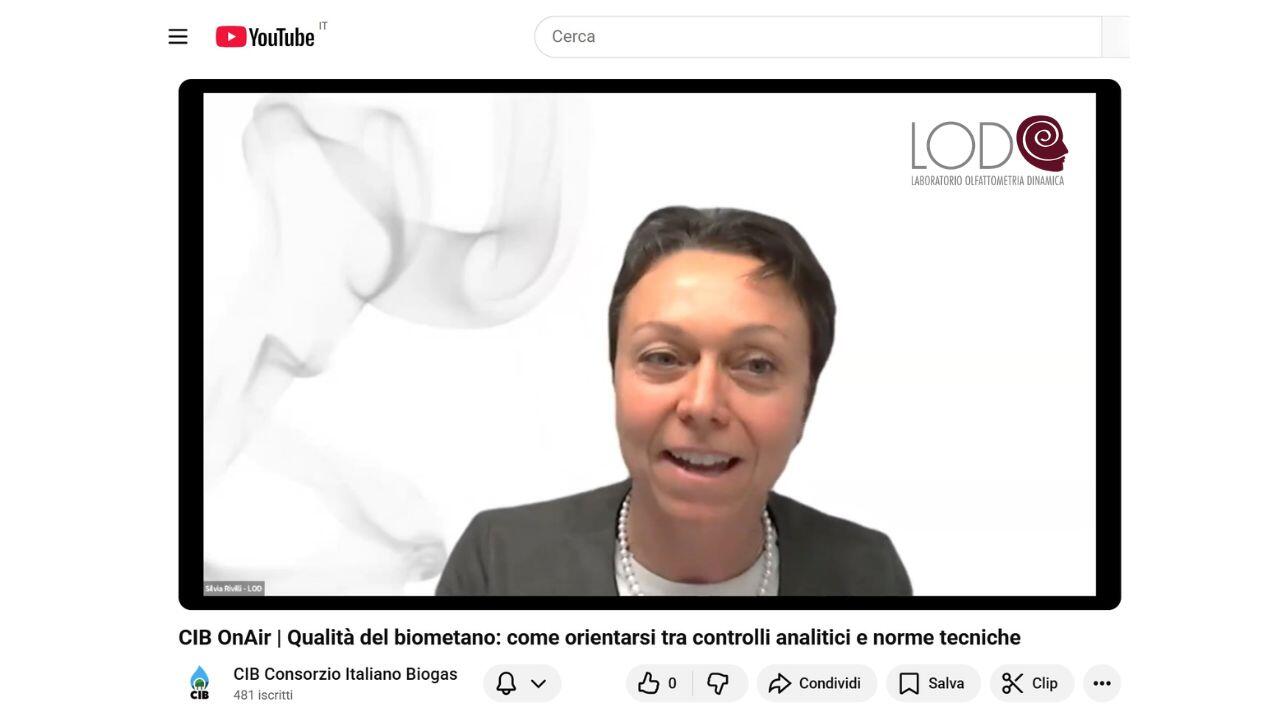
This topic was addressed during the webinar “CIB OnAir | Biomethane quality: how to navigate analytical controls and technical standards”, promoted by CIB - Consorzio Italiano Biogas e Gassificazione and aimed at a technical audience. The event provided a useful opportunity to clarify some key aspects related to biomethane injection into the grid, with particular focus on the relationship between analytical controls, technical standards and safety conditions. Within the round table, Silvia Rivilli, Technical Director of LOD, a supporting member of CIB, contributed the laboratory’s technical and applied perspective, focusing in particular on odorability testing and its practical implications for safety.
Biomethane odorability: the role of the rhinanalytical test
Special attention was given to the issue of biomethane odorability, as referred to in the grid code and further detailed in the applicable technical standards. In this context, Silvia Rivilli focused on the rhinanalytical test provided for by UNI 7133, which is required to verify that biomethane is actually odorisable and does not exhibit characteristics capable of nullifying or masking the effect of the odorants used in gas networks, such as THT or TBM.
This is a crucial step, because the correct perception of the gas odour is directly linked to the ability to promptly detect any leaks, with clear safety implications. As highlighted during the presentation, even very small quantities of certain compounds can significantly affect the olfactory response of the gas. For this reason, chemical analysis alone is not sufficient: specific testing is needed to assess in practical terms the interaction between biomethane and odorising substances.
Analysis, verification and regulation: the value of an integrated approach
The webinar confirmed the importance of addressing biomethane quality through a rigorous approach capable of integrating analytical controls, olfactory verification and regulatory knowledge. In this process, the contribution of specialised laboratories is essential in supporting operators and producers in the proper management of a process involving gas quality, continuity of service and system safety.
By taking part in discussions such as this, LOD reaffirms the value of a technical approach based on measurement, data interpretation and strict application of standards, in support of the supply chains operating in the biogas and biomethane sector.
If you are interested in watching the full webinar, click HERE.
